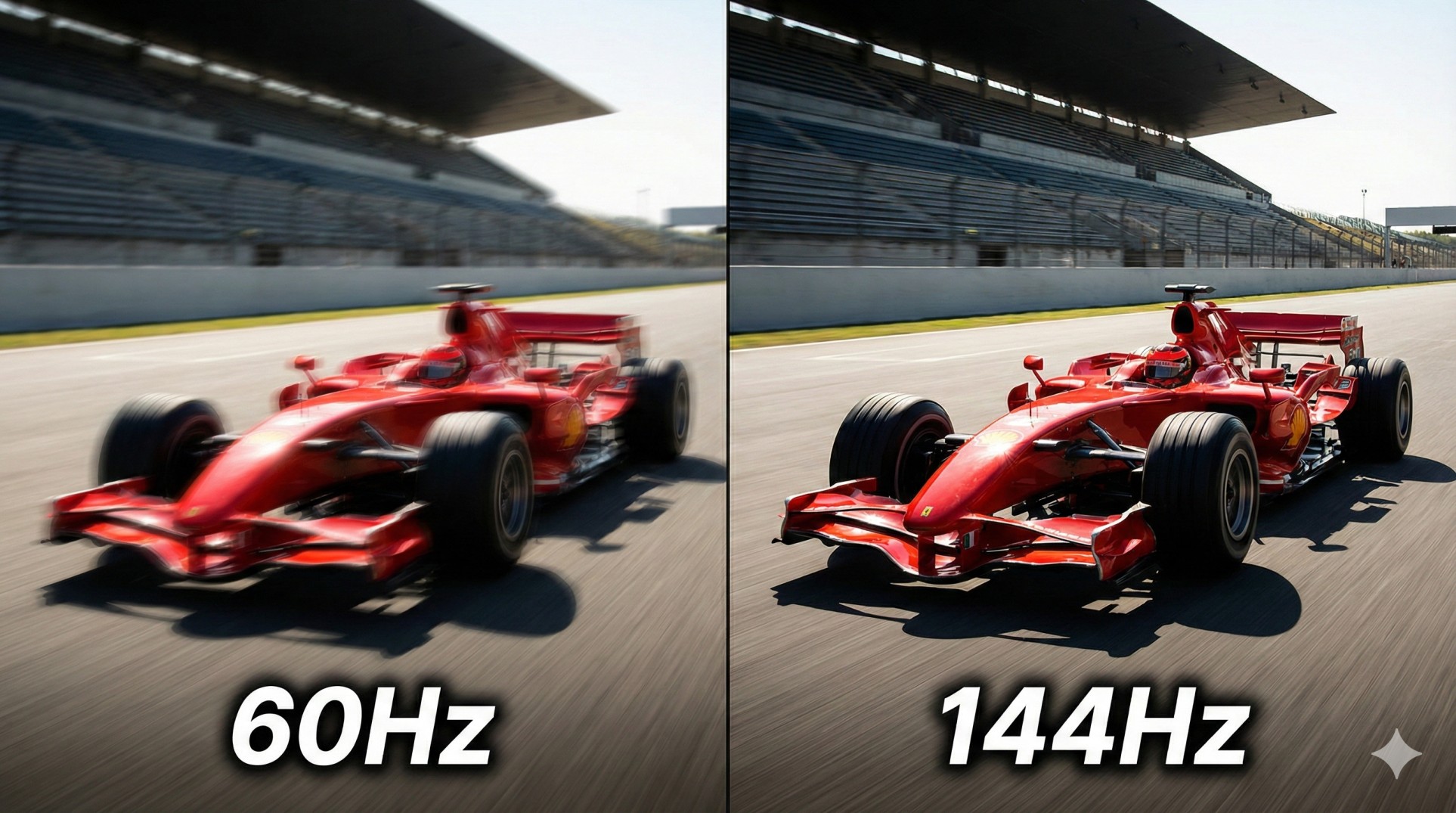
"You peek a corner in Valorant. You see the enemy. You click to shoot.
But you are already dead.
In the killcam, you see that he shot you before you even reacted. Is he a hacker?
Probably not. He just has a 144Hz monitor, and you are stuck on 60Hz. He literally saw you first."
Refresh Rate (measured in Hertz or Hz) is the number of times your screen updates with a new image every second. It's the difference between watching a flipbook and watching real life.
"Imagine a flipbook animation.
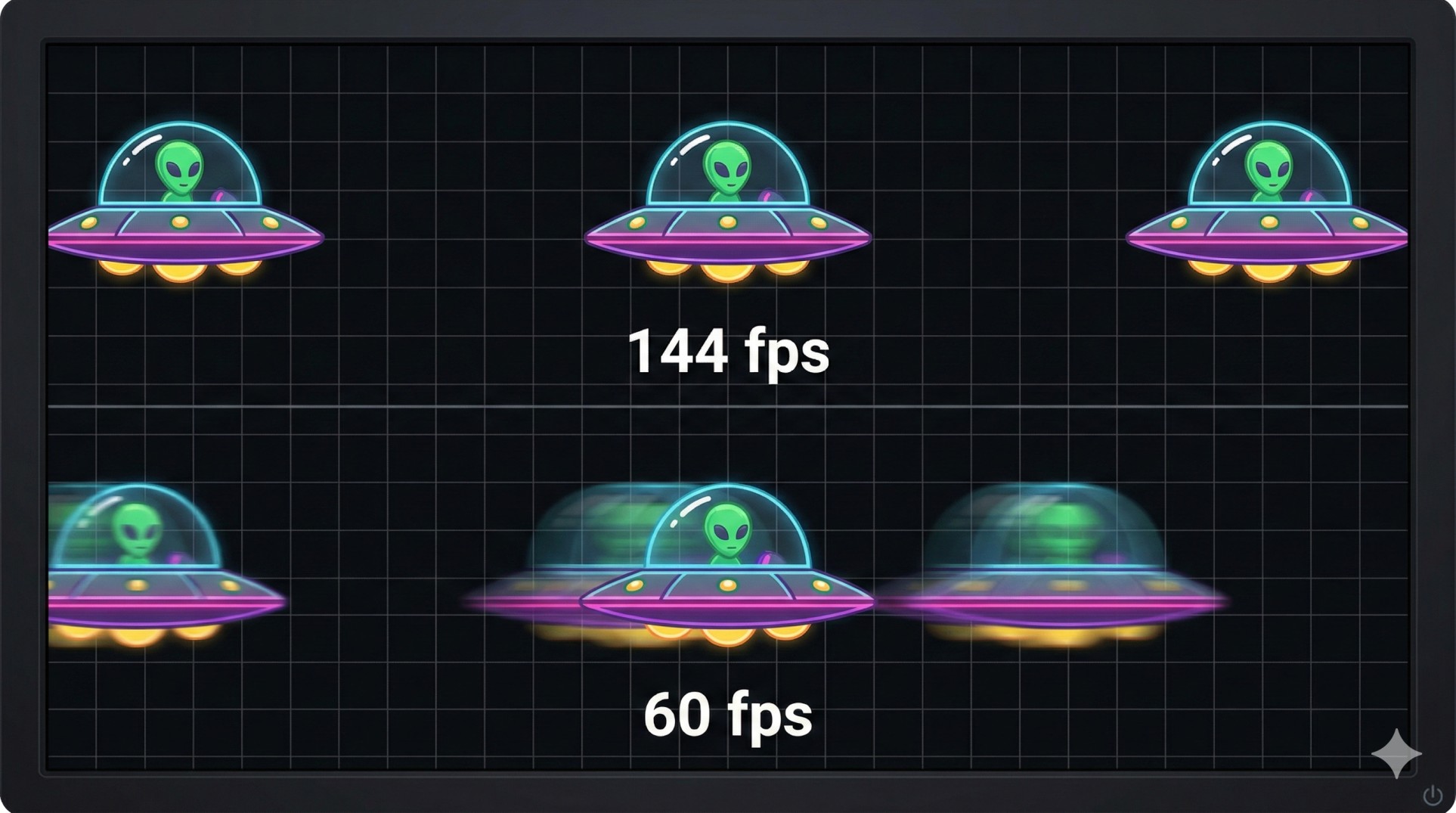
60Hz: You have 60 pages per second. Motion looks okay, but slightly blurry.
144Hz: You have 144 pages per second. Motion looks silky smooth. You can see every detail of a moving object."
1. The Visual Difference
It's hard to show in a screenshot, but the difference is "Buttery Smoothness".
- 60Hz (Standard Office): Mouse cursor trails, text blurs when scrolling, fast-moving enemies look like blurry ghosts.
- 144Hz (Standard Gaming): Everything is sharp. When you turn your camera quickly, the world doesn't turn into a blurry mess.
- 240Hz/360Hz (Pro Esports): Diminishing returns. It's better, but only superhuman pros can truly feel the difference over 144Hz.
2. The "Peeker's Advantage"
In competitive shooters, milliseconds matter. A higher refresh rate reduces "Input Lag".
At 60Hz, a new frame appears every 16.6ms.
At 144Hz, a new frame appears every 6.9ms.
That ~10ms saving allows you to track targets faster. It makes your aim feel more "connected" to your hand.
3. The Hardware Catch (Important!)
Buying a 144Hz monitor is useless if your PC is a potato.
Rule: To see 144Hz, your PC must generate 144 FPS (Frames Per Second).
If your game runs at 60 FPS on a 144Hz monitor, you are still seeing 60Hz. Upgrade your GPU before your monitor.
Conclusion: Is It Worth It?
YES. Upgrading to 144Hz is the single best upgrade for any gamer. Even moving the mouse on the desktop feels better. If you have the budget, ditch the 60Hz screen today.
Sound is just as important as vision. Check our Surround Sound Guide.